In 2026 your CRM sits at the center of a compliance maze: 20 US state privacy laws, maturing GDPR enforcement, the EU AI Act phasing in, and no federal standard to tie them together. Where your customer data lives, and who else can reach it, is now a decision you make on purpose. Here is how to think about it.
The maze got wider, not simpler
Privacy compliance this year means working across about 20 state laws, GDPR, and new AI-specific rules, with no single federal standard to fall back on. The threat side is climbing at the same time: roughly one in four malicious breaches now use AI, a 56% jump year on year, and the first half of 2026 already logged more than 1,800 data compromises.
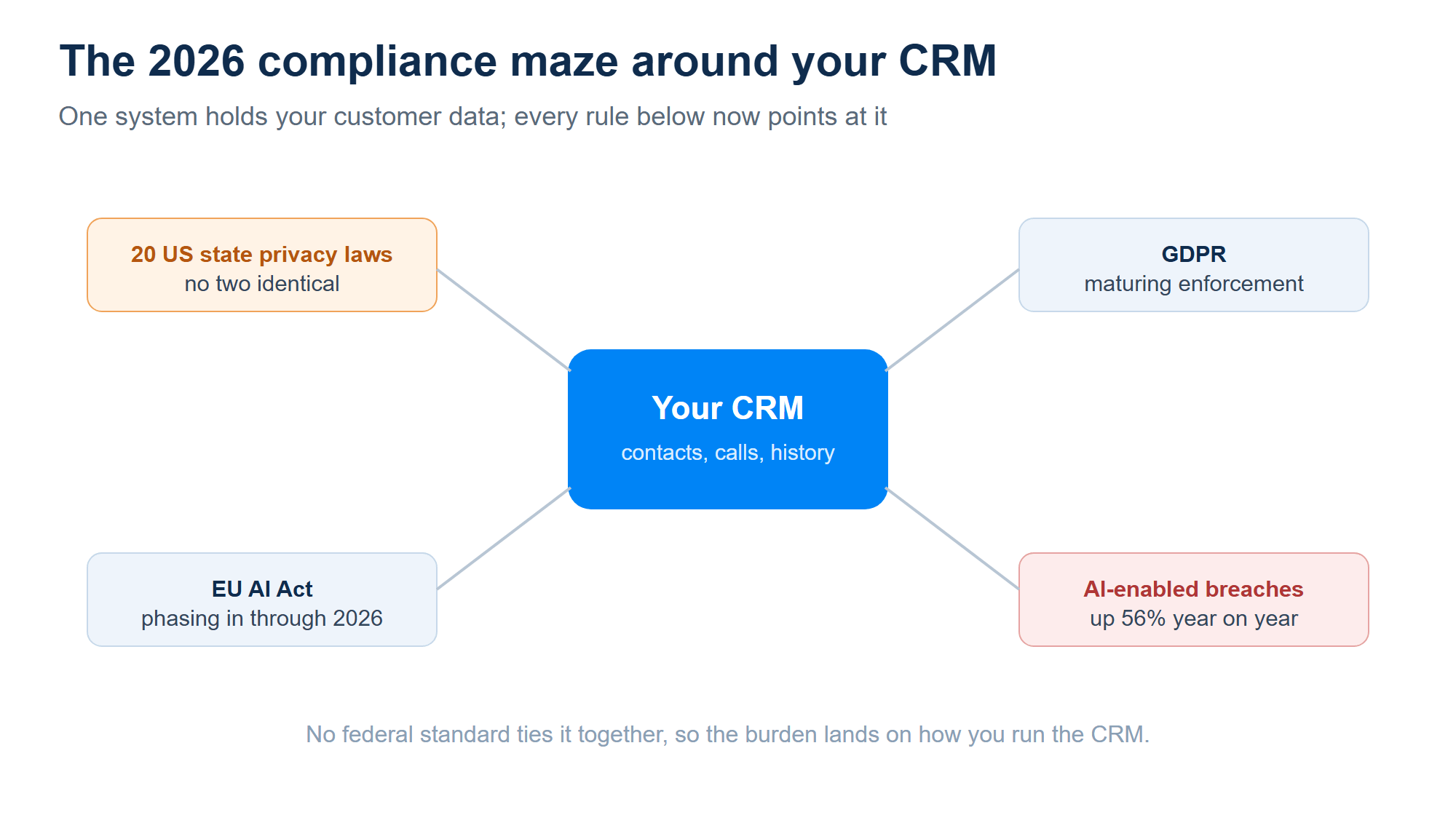
Your CRM holds the exact data all of this is about: names, numbers, emails, call history, notes. It is the highest-value target and the widest compliance surface you own.
Where your data lives changes your exposure
Two CRMs can follow the same rules and carry very different risk, because the rules apply to wherever the data actually sits.
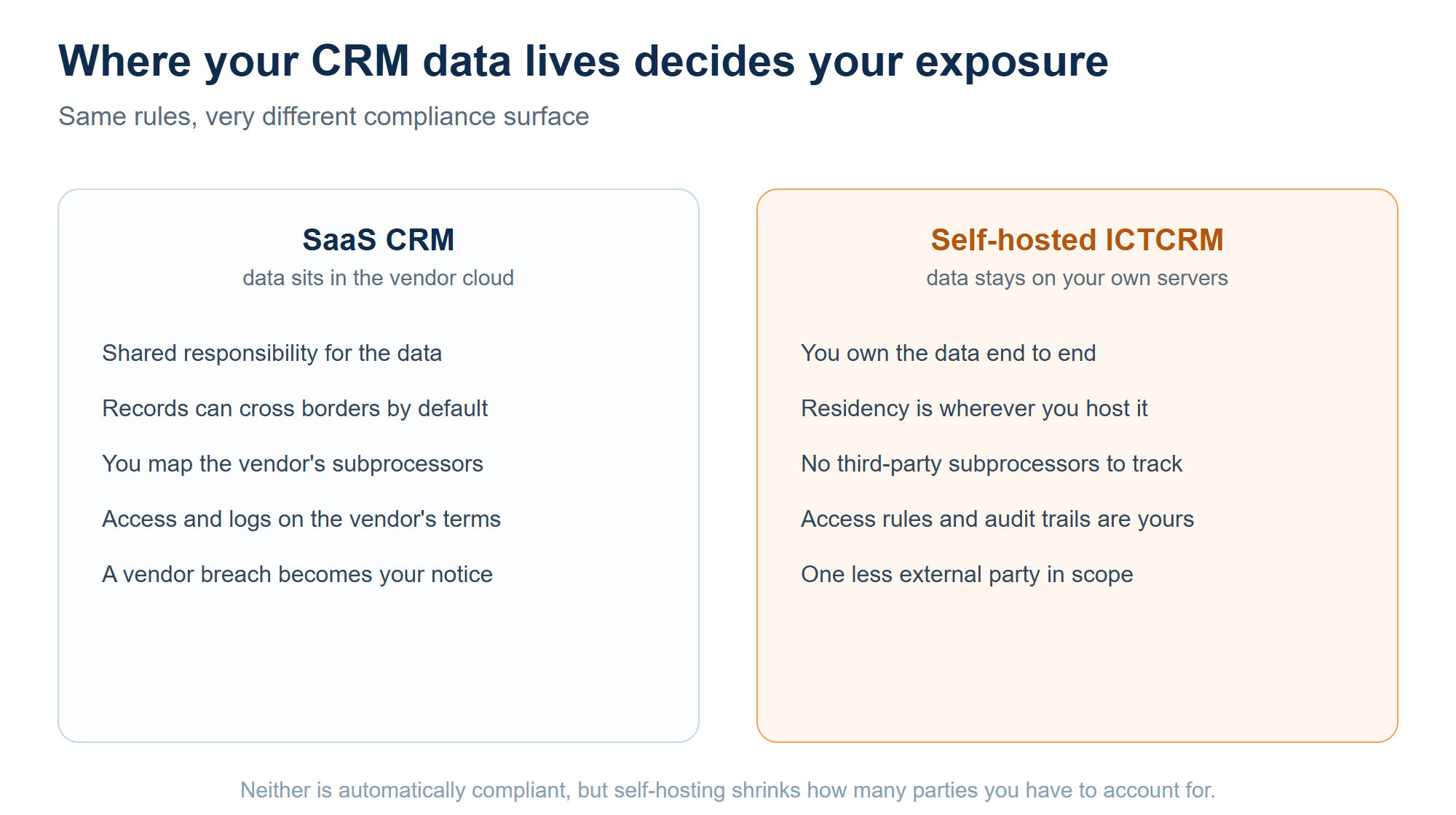
With a SaaS CRM, your records live in the vendor’s cloud. You share responsibility for them, they can cross borders by default, and you have to map every subprocessor the vendor uses. When the vendor is breached, the notice becomes yours to send. That is not hypothetical: in August 2026, attackers reached customer data held in a third-party CRM platform through nothing fancier than phone calls and texts posing as IT staff.
With a self-hosted CRM, the data stays on your own servers. You decide where it lives, who reaches it, and what the audit trail looks like. You still have to do the work, but there is one less outside party in scope when a regulator or an incident asks who held the data.
A practical checklist
- Know where your data physically sits, and under which laws.
- Cut the number of parties who can touch it. Fewer subprocessors, fewer questions.
- Turn on real access control and audit logging, per user.
- Treat social engineering as the main breach path. Most CRM breaches now start with a convincing phone call, not a zero-day.
- Keep export and deletion easy, because state laws increasingly require both on a deadline.
Where ICTCRM fits
ICTCRM installs on your own servers, so your customer data and the contact center that works it live in one place you control. That does not make you compliant on its own, but it shrinks how many parties you have to account for, and it puts data residency, access rules, and audit trails in your hands. Browse the features or the pricing to see how the open source CRM software is set up.
Frequently asked questions
Is there a federal US privacy law in 2026?
No. There are around 20 separate state laws and no overarching federal standard, so your obligations depend on where your customers live.
Does self-hosting a CRM make me compliant?
No. It reduces the number of outside parties in scope and gives you control over residency and access, but you still have to configure and run it properly.
What does the EU AI Act have to do with my CRM?
If your CRM uses AI features, the Act’s phased rules can apply to how those features handle personal data. Knowing where the processing happens matters.
Are CRM breaches mostly technical hacks?
Increasingly no. Many start with social engineering, a convincing call or text to an employee. Access control and staff awareness matter as much as patching.
What is the fastest win?
Map where your CRM data lives and who can access it, then cut that list down.
The patchwork is not going to simplify soon. The teams that stay calm are the ones who know exactly where their customer data sits and can prove who has touched it. Owning that answer is easier when you own the system.
Recent Comments