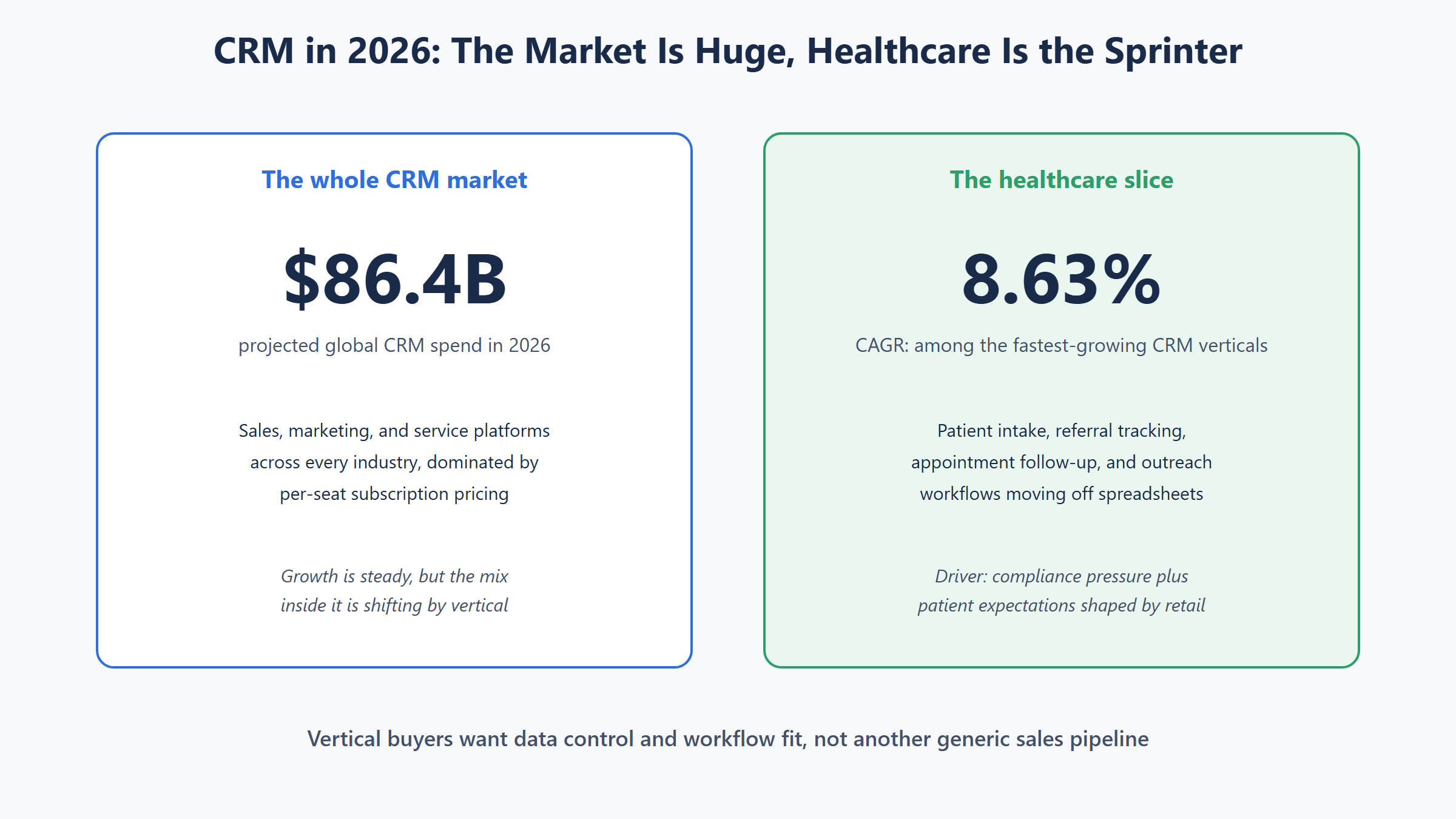
Two numbers from this month’s market research tell an interesting story. Global CRM spending is heading toward $86.4 billion in 2026, and inside that total, healthcare CRM is growing at an 8.63% compound rate, making it one of the fastest-moving verticals in the whole category. Clinics, therapy practices, labs, and home-care agencies are buying CRM software in volume for the first time. And a lot of them are about to discover that the mainstream options weren’t built with them in mind.
Why Healthcare Is Buying CRM Now
The growth isn’t mysterious. Patient expectations got reshaped by retail: people who can track a pizza expect appointment reminders, follow-up messages, and a front desk that knows their history. Meanwhile referral leakage, the patients who get referred out and never book, costs practices real revenue that a tracked pipeline recovers. And the compliance environment keeps tightening, with new rules this year pushing healthcare organizations toward systems that log who touched what record and when.
So the workflows moving into CRM software are concrete: intake forms that feed a patient record, referral stages tracked like a sales pipeline, appointment follow-up sequences, and outreach lists for recalls and screenings. None of that is exotic. What’s distinctive is the constraint underneath it all: the data is regulated.
The Problem With Renting a CRM for Regulated Data
Mainstream cloud CRM answers the compliance question with a business associate agreement and a premium tier. That works, but look at what you’re actually buying: your patient data sits on a vendor’s infrastructure, your audit trail is whatever their plan exposes, and your cost scales per seat, which punishes exactly the kind of team healthcare runs, lots of front-desk, scheduling, and outreach staff who each need light access.
A practice with 4 clinicians might have 15 people touching the CRM. At typical per-seat pricing, the receptionists cost more than the doctors. I’ve yet to hear a practice manager defend that math once they’ve seen the alternative.
Where Open Source CRM Software Fits
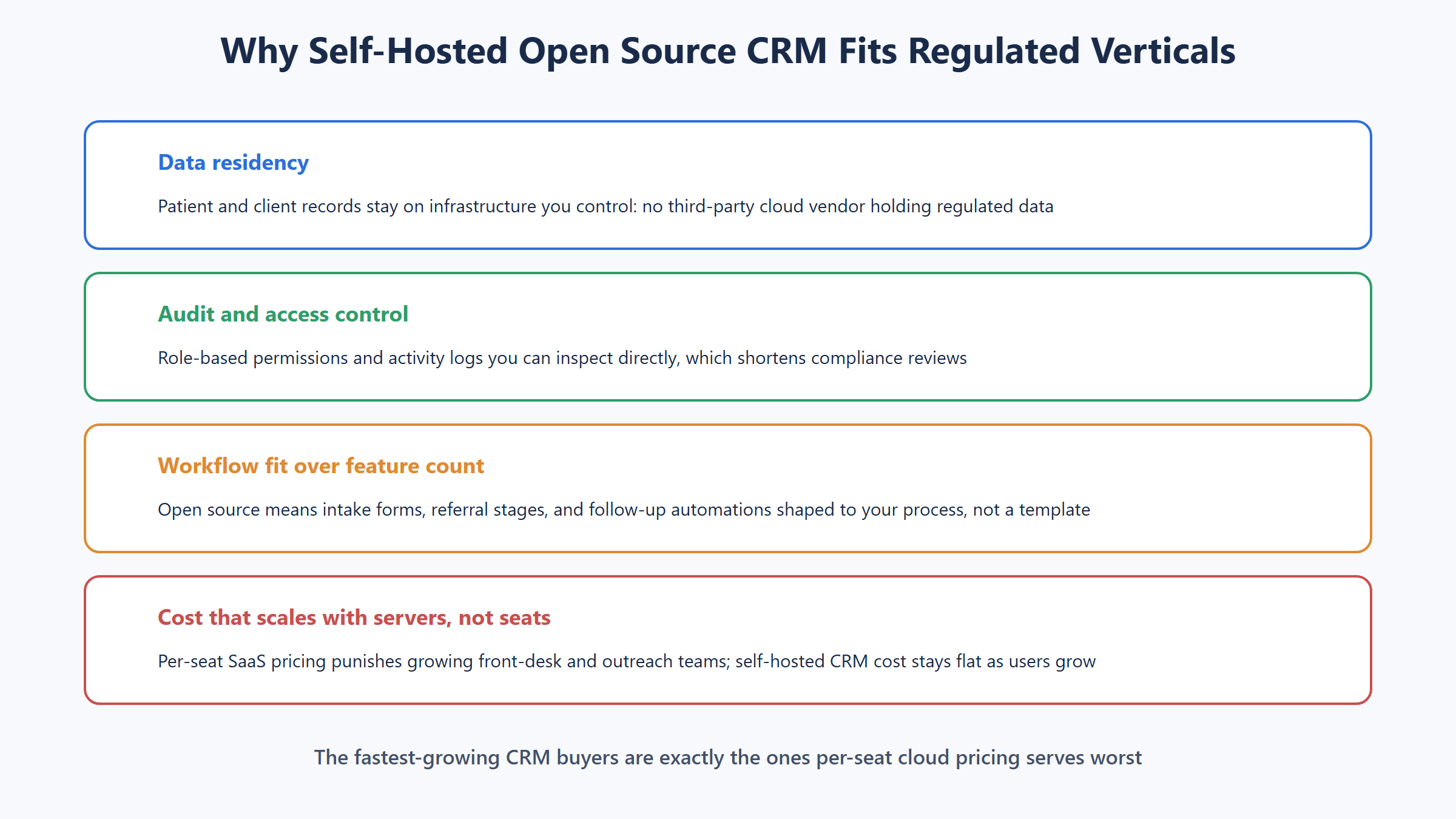
Self-hosted open source CRM software answers each of those constraints structurally instead of contractually. Records live on servers you control, so data residency stops being a vendor negotiation. Access controls and activity logs are yours to inspect and extend. Intake and referral workflows get shaped to your actual process rather than a template built for software sales teams. And cost scales with your server, not your headcount, so adding three schedulers in October costs nothing.
There’s a second fit that healthcare buyers tend to underrate until they need it: communication channels. A referral follow-up is a phone call. A recall campaign is a voice or SMS outreach list. ICTCRM builds on this by pairing CRM records with telephony directly, the approach we’ve detailed in open source CRM with VoIP, running on a FreeSWITCH foundation so calls, recordings, and contact history live in one system. For a practice, that means the follow-up call happens from inside the patient’s record and gets logged there, which is the audit trail compliance reviewers actually want to see.
One honest caveat: self-hosting means someone has to host it. A solo practice with no IT support may be better off renting, at least at first. The economics flip somewhere around the point where per-seat fees exceed the cost of a modest VPS and a few hours of setup, and most multi-provider practices are past that point on day one.
What to Evaluate Before You Commit
Whatever you pick, test three things against your real workflow before signing or installing anything. First, intake: can a web form create a contact with your fields, not the vendor’s? Second, the referral pipeline: can you rename stages and trigger follow-ups on stage changes? Third, communication logging: when staff call a patient, does the interaction attach to the record automatically? The ICTCRM feature set covers all three, and the omnichannel side of that is worth a look if your outreach spans voice, SMS, and email together.
Healthcare’s CRM surge will keep pulling the market’s center of gravity toward regulated, workflow-heavy buyers. Vendors will chase it with compliance add-ons and vertical editions. The structural answer, keeping the data and the workflow under your own roof, was available all along.
FAQ
How big is the CRM market in 2026?
Industry projections put global CRM spending at roughly $86.4 billion in 2026, with continued growth driven by AI features and vertical-specific adoption. Healthcare is among the fastest-growing segments at an 8.63% compound annual rate.
Why is healthcare CRM growing so fast?
Rising patient expectations for retail-style communication, revenue lost to untracked referrals, and tightening compliance requirements are pushing practices off spreadsheets and into systems with logged, auditable workflows.
Is open source CRM software suitable for healthcare?
Yes, with proper setup. Self-hosting keeps patient data on your own infrastructure, access controls and audit logs are fully inspectable, and workflows can be shaped to clinical intake and referral processes. You remain responsible for securing the server it runs on.
What does self-hosted CRM cost compared to per-seat SaaS?
Self-hosted CRM costs scale with your server, not your user count. Teams with many light-access users, like front-desk and outreach staff, typically save the most, since per-seat SaaS charges the same for a receptionist as for a manager.
Why does CRM and telephony integration matter for practices?
Most patient follow-up happens by phone. When the CRM and phone system are one platform, calls launch from the patient record and log to it automatically, producing the interaction history that both staff and compliance reviews need.
Recent Comments